
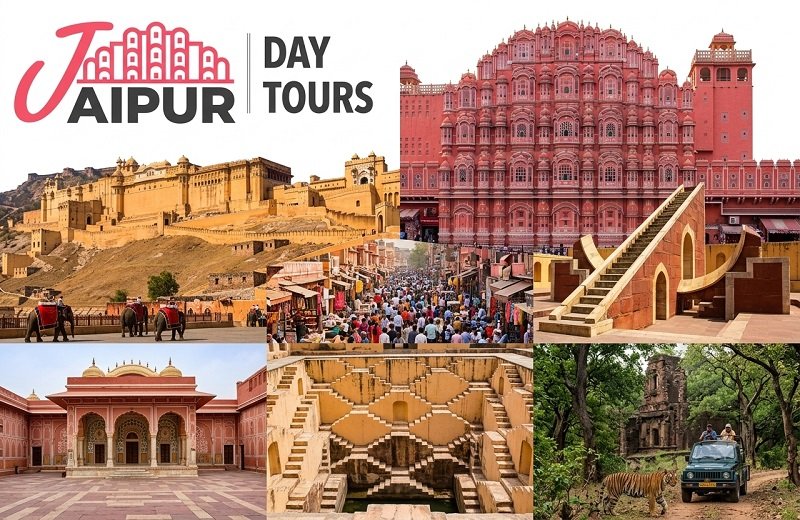
Most people land in Jaipur with a rough idea of what they want to see – a fort, a palace, maybe that famous pink building everyone photographs. What they don’t always realize is how much ground the city actually covers, and how easy it is to lose half a day just moving between sites if the route isn’t planned properly. A Jaipur City Tour Package solves that problem by grouping the major landmarks in a sensible order. Below is a breakdown of what you’ll typically see, along with a few details that guidebooks tend to skip over.
Discover Amber Fort and Its Royal Legacy
Amber Fort is the one almost nobody skips. It sits on a hill roughly eleven kilometers outside the city, and most tours start here simply because it takes the longest to explore properly. Inside, the Sheesh Mahal is worth slowing down for – it’s a hall covered in tiny mirrored panels, originally designed so a single candle could light the entire room through reflection. There’s also a fair bit of walking involved, since the fort spreads across several courtyards and levels, so wear shoes you don’t mind climbing stairs in. Plan for at least two hours if you want to actually take it in rather than rush through.
Explore City Palace and Jantar Mantar
City Palace is a strange mix – part museum, part still-functioning royal residence. You’ll find old costumes, weaponry, and manuscripts on display, and the architecture itself shifts between Rajasthani and Mughal styles depending on which courtyard you’re standing in. Right next door is Jantar Mantar, an observatory built in the 1700s that used massive stone instruments to track the sky. It sounds like a minor stop on paper, but the scale of the instruments tends to surprise first-time visitors. Since both sites are within walking distance of each other, they usually get paired in the same block of time.
Walk Through Hawa Mahal and Old City Markets
Hawa Mahal gets photographed constantly, and honestly, it photographs better from outside than from within. The honeycomb of small windows was built so royal women could watch the street below without being seen themselves – a small architectural workaround for a fairly rigid social rule at the time. Most tours stop just long enough for a few pictures before heading into the old city markets nearby. Bapu Bazaar and Johari Bazaar are worth a slower walk if you have the time, since they’re where a lot of Jaipur’s textile and jewelry trade actually happens, not just for tourists.
Jaipur City Tour Package – Complete Overview
What actually gets included in a Jaipur City Tour Package depends a lot on the operator, so it’s worth reading the fine print before booking. Generally, it covers transport between sites, coordination for entry tickets, and a guide who can walk you through the history rather than leaving you to read placards. Some packages throw in a meal stop as well, usually a Rajasthani thali somewhere along the route. Where operators differ is in the details – whether entry fees are bundled in or billed separately, and whether the vehicle is shared or private. It’s a small thing, but it affects both cost and comfort.
Jaipur Sightseeing Packages for Extended Exploration
If a single day feels too tight, broader Jaipur Sightseeing Packages exist for travelers who want to spread things out. These often bring in spots that don’t make the standard list – Albert Hall Museum, Birla Mandir, or the Gaitore cenotaphs, where several former Jaipur rulers are memorialized. None of these are must-see in the way Amber Fort is, but they add depth if you’re staying two or three days instead of rushing through in one.
Nahargarh Fort and Jaigarh Fort Views
Nahargarh Fort tends to show up on evening itineraries because of the view – the whole city spreads out below it, and sunset from up there is genuinely worth the trip. Jaigarh Fort, close to Amber, is known for something more specific: Jaivana, one of the largest cannons on wheels ever built. Both forts were designed for defense rather than display, and walking their walls gives a much more practical sense of how the city was protected centuries ago. They also draw far fewer crowds than Amber Fort, which is reason enough to visit if you’d rather skip the queues.
Panna Meena Ka Kund – Jaipur Step Well Experience
Tucked near Amber Fort is Panna Meena Ka Kund, a Jaipur Step Well that doesn’t get nearly enough attention. Step wells like this were built to store water and offer some relief from the heat, and the symmetry of the staircases descending from all four sides is honestly striking in person. It’s become something of a photography spot in recent years, but its original purpose – water conservation in a dry climate – is easy to forget standing at the top looking down. If your route already passes near Amber Fort, it’s a short detour that’s worth taking.
Wildlife Adventure with Jaipur Tiger Safari
For travelers who want more than forts and palaces, a Jaipur Tiger Safari at Ranthambore National Park is a common add-on. It’s about three to four hours from Jaipur by road, so it usually means an overnight stay or a very early start. What makes Ranthambore different from other wildlife parks is the setting – tigers moving through a landscape scattered with old ruins, rather than open grassland. It’s not something you can fit into a single city-tour day, but operators often package it as an extension for anyone with a spare day or two.
Extending Your Journey with Rajasthan Tour and Travel Packages
Jaipur often works as a launch point for wider Rajasthan Tour and Travel Packages that connect it with Udaipur, Jodhpur, and Jaisalmer. Each city has a different personality – Udaipur’s lakes, Jodhpur’s blue-washed old town, Jaisalmer’s desert edges – and stringing them together gives a fuller picture of the state than Jaipur alone can offer. The catch is distance. Road travel between Rajasthan’s cities can eat up a full day if the route isn’t sequenced well, so it helps to book through someone who actually knows the geography rather than just listing cities on a map.
Pushkar Tour Package for a Day Trip Beyond Jaipur
About three hours from Jaipur sits Pushkar, a much quieter town that’s easy to add as a day trip or overnight stop. A Pushkar Tour Package usually centers on the Brahma Temple, one of the very few temples in India dedicated to Brahma, along with Pushkar Lake, which holds religious significance for many visitors. The pace here is noticeably slower than Jaipur – narrow lanes, small shops selling handmade goods, and a general lack of the traffic and noise you get in the bigger city. It’s a good breather if you’ve spent a few days moving fast through forts and markets.
Conclusion
There’s no single “right” way to see Jaipur – it really depends on how much time you have and what you’re drawn to. Someone with a single day will hit the core landmarks: Amber Fort, City Palace, Hawa Mahal, and maybe Jantar Mantar if the timing works out. Someone with more time can push further, toward Ranthambore’s forests or Pushkar’s quieter streets, or even out to other cities across the state. What matters most is being realistic about distances and not trying to cram too much into too little time. Look closely at what a package actually includes before booking, pace the day sensibly, and the trip tends to take care of itself.
Frequently Asked Questions (FAQs)
Que. How many days are needed to cover the major sites in Jaipur?
Ans. One full day is usually enough for the core sites – Amber Fort, City Palace, Jantar Mantar, and Hawa Mahal – though a second day makes the pace far less rushed.
Que. Is it necessary to hire a guide while visiting these monuments?
Ans. Not strictly, no, but it makes a real difference at places like City Palace and Jantar Mantar, where the history isn’t always obvious just from walking around.
Que. What is the best time of year to visit Jaipur?
Ans. October through March tends to work best, mainly because the heat drops to something manageable for walking around open forts and courtyards all day.
Que. Can a wildlife visit to Ranthambore be combined with a Jaipur trip?
Ans. Yes, it’s a common add-on, though it needs its own block of time since the travel alone takes several hours each way.
Que. Are step wells like Panna Meena Ka Kund open to the public throughout the day?
Ans. Generally yes, and visiting earlier in the day is worth it – both for cooler weather and smaller crowds later on.
