
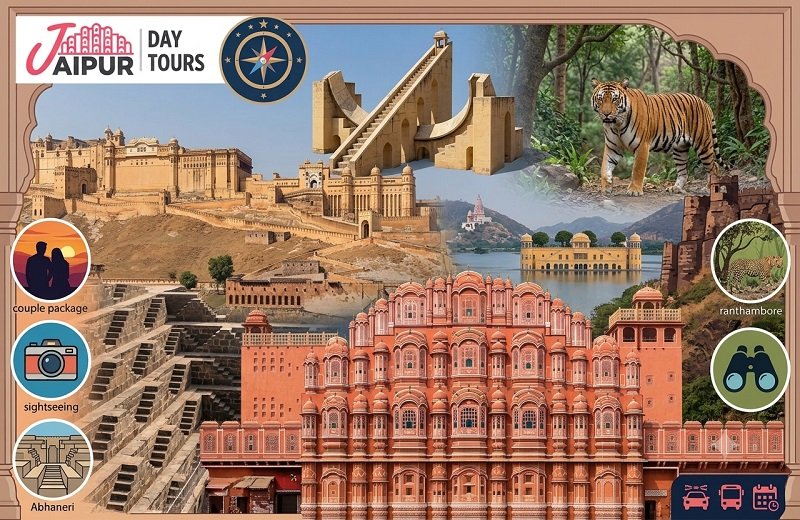
Jaipur stands as one of India’s most visited heritage destinations. Its pink sandstone buildings, fortified walls, and royal complexes give visitors a clear window into Rajput history and architecture. A well-planned visit helps travelers understand how the city developed under the Kachwaha rulers and how its monuments still shape daily life. This guide explains the main sites, related regional routes, and practical points that academic studies of Rajasthan tourism often highlight.
Exploring Jaipur City Tour Landmarks
The central part of any Jaipur City Tour focuses on the old walled city and its immediate surroundings. Amber Fort, located a short drive north of the city, shows the transition from defensive hill fort to royal residence. Visitors walk through successive courtyards, note the mirror work in the Sheesh Mahal, and observe the water-harvesting systems that once supported the fort. From the upper terraces, the view of Maota Lake and the surrounding hills illustrates why the site was chosen for strategic control.
Inside the city walls, City Palace remains the heart of the former royal complex. The complex contains museums that display textiles, weapons, and manuscripts. Adjacent to it stands Jantar Mantar, an astronomical observatory built in the early eighteenth century. Its large stone instruments still demonstrate how local scholars measured time, predicted eclipses, and tracked planetary movements. Hawa Mahal, the five-story façade of lattice windows, was designed so women of the court could observe street processions without being seen. These three sites form the classic core that most visitors encounter on a single day.
Beyond the main monuments, smaller locations add depth. The Albert Hall Museum holds collections of pottery, jewelry, and miniature paintings that document trade links between Rajasthan and other regions. Local markets around Bapu Bazaar and Johari Bazaar show continuing craft traditions in textiles, gemstones, and metalwork. Academic surveys of urban heritage note that these living markets help maintain economic continuity with the city’s past.
Understanding Jaipur Sightseeing Tour Package Components
A typical Jaipur Sightseeing Tour Package arranges transport, entry tickets, and a guide so that the main monuments can be visited without logistical delays. Packages usually begin early to avoid midday heat and crowds at Amber Fort. They then move to the city-center sites before the afternoon light softens the pink stone façades. Some packages include a stop at Jal Mahal, the partially submerged palace in Man Sagar Lake, where the surrounding wetlands attract migratory birds in winter.
Guides trained in local history explain construction techniques, patronage patterns, and the social rules that shaped palace life. Research on heritage interpretation stresses that accurate, context-rich commentary improves visitor understanding more than simple listing of dates. Packages that allow flexible timing also let travelers pause at lesser-known corners such as the Gaitor cenotaphs or the old city gates, places that reveal how the urban layout was planned for defense and ceremony.
Insights into Rajasthan Tour Packages for Couple
Travelers planning longer stays often look at Rajasthan Tour Packages for Couple. These itineraries typically combine Jaipur with one or two additional destinations so that the experience remains manageable in length and intensity. Shared transport, private rooms, and quiet evening stops at heritage hotels or lakeside viewpoints are common features. The slower pace allows couples to walk through palace gardens, watch sunset light on fort walls, and sample regional cuisine without rigid schedules.
Studies of leisure travel in India note that couples often prefer destinations that mix cultural depth with moments of relative calm. In Rajasthan, this balance appears in the contrast between busy city streets and the open courtyards of forts or the quieter banks of artificial lakes. Packages designed with this preference in mind avoid overcrowded group timings and leave space for independent exploration.
Planning a Jaipur Ranthambore Trip
Many visitors extend their stay by adding a Jaipur Ranthambore Trip. Ranthambore National Park lies roughly 180 kilometers southeast of Jaipur and is known for its tiger population and the ruined fort that stands inside the reserve. Early-morning and late-afternoon jeep safaris move along designated tracks through dry deciduous forest and around lakes that attract deer, birds, and predators.
The fort itself, with its temples and broken walls, shows how human settlement once existed within what is now protected habitat. Wildlife biologists and park managers emphasize that regulated vehicle numbers and fixed routes help reduce disturbance. Travelers who spend one or two nights near the park gates gain a clearer sense of the daily rhythm of the forest than those who attempt a rushed day visit.
Details on Jaipur to Abhaneri Routes
A half-day or full-day excursion covers Jaipur to Abhaneri. The village is famous for Chand Baori, one of the deepest and most geometrically precise stepwells in India. Descending the stepped sides reveals how the structure collected and stored rainwater in an arid region. Adjacent temples and the remains of a nearby fort place the stepwell within a larger historical landscape of water management and religious architecture.
Scholars of traditional Indian hydrology point out that stepwells served both practical and social functions. They provided water, offered cool resting places, and sometimes hosted community gatherings. Visiting Abhaneri after seeing Jaipur’s palaces helps travelers understand the contrast between royal display and the quieter engineering solutions that sustained ordinary life.
Overview of Jaipur Pushkar Tour Experiences
Another popular extension is the Jaipur Pushkar Tour. Pushkar lies about 150 kilometers west of Jaipur and centers on a sacred lake and the Brahma Temple. The town’s ghats, whitewashed houses, and surrounding hills create a different atmosphere from the pink sandstone of Jaipur. Visitors often time their stay to coincide with the annual cattle fair, when traders, pilgrims, and performers gather, or they choose quieter months to walk the lake perimeter and climb the nearby Savitri Temple hill for panoramic views.
Religious studies researchers note that Pushkar’s importance rests on its association with the creator deity and on the continuous ritual use of the lake. Combining the visit with Jaipur allows travelers to move from a fortified capital to a pilgrimage center, illustrating two distinct but connected strands of Rajasthan’s cultural history.
Practical Considerations for Visitors
Weather, entry timings, and local transport shape the experience. October to March offers cooler temperatures suitable for walking between sites. Summer months require early starts and frequent rest in shaded courtyards. Most major monuments open by mid-morning and close before sunset. Auto-rickshaws, taxis, and organized coaches handle movement inside the city, while longer routes to Ranthambore, Abhaneri, or Pushkar are best covered by hired car or scheduled coach.
Respect for local customs, modest clothing at religious sites, and careful use of water and electricity in hotels align with broader principles of responsible travel. Academic literature on sustainable tourism in heritage cities repeatedly stresses that visitor behavior influences both the physical condition of monuments and the quality of life for residents.
Conclusion
A visit centered on Jaipur’s forts, palaces, and observatories gives a solid foundation in the region’s architectural and political history. Adding carefully chosen extensions to Ranthambore, Abhaneri, or Pushkar broadens the picture to include wildlife, traditional water systems, and pilgrimage practices. When these elements are approached with accurate information and realistic pacing, the result is a coherent understanding of how landscape, climate, and human ambition shaped this part of Rajasthan.
Frequently Asked Questions (FAQs)
Que. What are the must-see monuments on a first visit to Jaipur?
Ans. Amber Fort, City Palace, Jantar Mantar, and Hawa Mahal form the essential core. Together they illustrate defense, royal life, scientific observation, and architectural display.
Que. How many days are usually needed for the main sites plus one nearby excursion?
Ans. Three full days allow the principal monuments in Jaipur and one day trip to either Abhaneri or a short safari at Ranthambore without excessive haste.
Que. Is it practical to combine Jaipur with both Ranthambore and Pushkar in a single week?
Ans. Yes, provided travel days are planned carefully. One or two nights at each additional location keep the itinerary manageable and reduce fatigue.
Que. What time of year offers the most comfortable conditions for outdoor sightseeing?
Ans. The months from October through March provide cooler temperatures and clearer light, making extended walking and fort climbs more comfortable.
Que. Are guided explanations useful at the astronomical instruments of Jantar Mantar?
Ans. Yes. The large stone devices become clearer when their function and historical context are explained by someone familiar with the site’s scientific purpose.
