
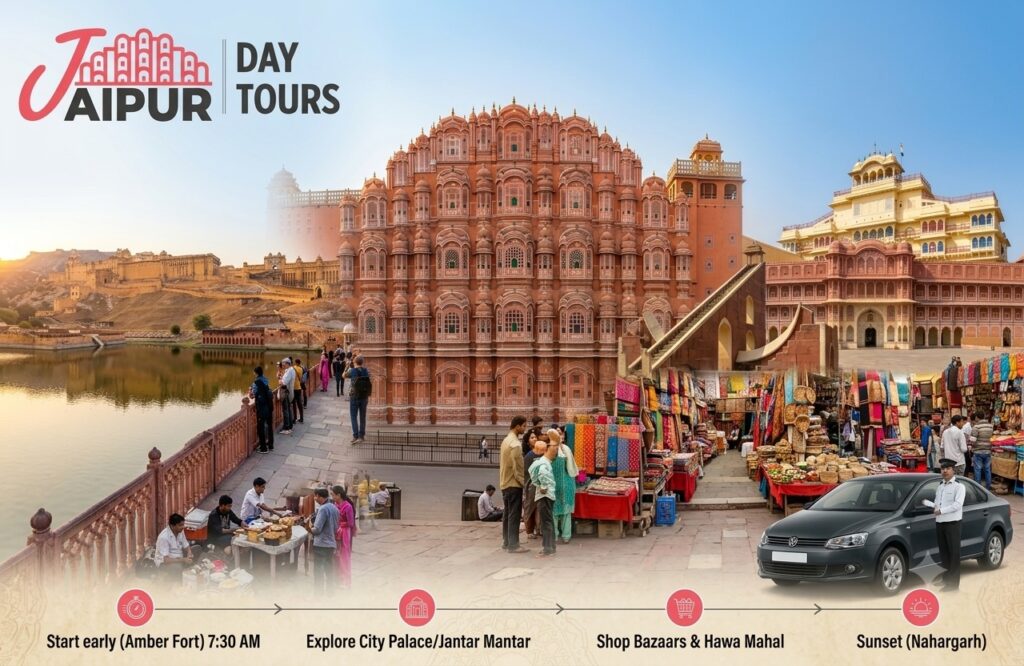
You can’t really “do” Jaipur in a day. Not properly. But you can see the parts of it that matter most, if you plan the route before you leave the hotel and don’t waste the morning deciding where to go first. The Pink City earned its name from the sandstone walls painted terracotta in 1876, ahead of a royal visit, and that color still runs through the old quarter today. Below is a route that actually works within a single day, based on how far things really are from each other and when the gates open, not on some idealized version of the trip.
Why a Jaipur Sightseeing Tour Depends on Your Start Time
Here’s the thing most people get wrong: they plan the stops but not the clock. A one-day Jaipur Sightseeing Tour lives or dies on when you get moving. Amber Fort opens around 8 am, and by 10, tour buses start pulling in from every direction. If you’re standing at the gate when it opens, you get quiet courtyards and soft light. If you show up at 11, you get a queue and a headache. Summer makes this worse – the heat by noon is no joke, and it drains energy fast. So the plan is simple: be out the door by 7:30, no matter how tempting it is to sleep in after a late flight.
Amber Fort First, Always
Amber Fort sits about 11 km out of the city, up on a ridge above Maota Lake, and it’s the obvious first stop for a reason. Give it ninety minutes at least. The Sheesh Mahal alone is worth lingering in – thousands of tiny mirror fragments set into the walls, originally lit by candlelight to create a kind of starlit effect indoors. Climb up to the ramparts if your knees allow it. The view over the hills is the kind of thing photos never quite capture. Getting here on your own is a hassle, honestly, which is one reason most people don’t try.
Jaigarh or Nahargarh – Pick One, Not Both
Jaigarh Fort is a short hop from Amber and holds the Jaivana cannon, once the largest cannon on wheels anywhere in the world. It’s impressive, but if your day is already tight, this is the stop most people cut. Nahargarh Fort is the better bet for sunset, up on a hill with the whole city spread out below in that golden late-afternoon light. Trying to fit both forts into one day alongside everything else usually means rushing through both and enjoying neither. Pick the one that matters more to you and let the other go.
City Palace and Jantar Mantar, Side by Side
Back down in the old city, City Palace is still partly a royal residence, with sections open for visitors – armories, courtyards, a mix of Mughal and Rajasthani architecture that doesn’t feel forced together the way it sometimes does elsewhere. Right next door is Jantar Mantar, an 18th-century observatory built by Maharaja Jai Singh II. The instruments look almost sculptural at first glance, oversized stone shapes with no obvious purpose, but each one was built to track time or star positions with startling accuracy for its era. Plan for around two hours here between both sites; they’re close enough that you won’t waste time walking.
Hawa Mahal and a Walk Through the Bazaars
Hawa Mahal – the Palace of Winds – is probably the most photographed building in the state, and it’s almost entirely a facade. 953 small windows, built so the women of the royal household could watch street life below without being seen themselves. Fifteen minutes outside is usually enough. From there, wander into Johari Bazaar and Bapu Bazaar, where the real texture of the old city shows up – gemstones, block-printed fabric, leather juttis stacked in open-fronted shops. A lot of travelers get overcharged here simply because they don’t know what fair pricing looks like, which is exactly where a Jaipur Private Shopping Tour tends to earn its keep, since a local guide usually knows which shops deal fairly and which ones are set up purely for tourists.
Getting Around Without Losing the Day to Traffic
None of this works on foot. Jaipur’s sights are scattered wide, and walking between them would eat your whole day before lunch. This is where a decent Car Rental Service in Jaipur actually changes the outcome. A good one gives you a driver who already knows which roads jam up by 10 am and which stay clear, flexible pickup for that early start, and a vehicle with air conditioning that you will absolutely want by early afternoon. Some services charge by the hour, others by the full day – either works, but ask upfront so there’s no confusion later. What you’re really paying for isn’t the car. It’s someone who’s driven this route a hundred times and knows how to save you an hour you didn’t know you were losing.
Don’t Skip the Food, Even If You’re Short on Time
Food doesn’t need its own block in the itinerary – just don’t skip it entirely. Small stalls near Johari Bazaar sell pyaaz kachori that’s worth the five-minute detour, and ghewar if you’ve got a sweet tooth. A quick thali stop somewhere in the old city, built around dal baati churma, gives you a real taste of Rajasthan without eating into your afternoon. Keep it short. Sit-down restaurants are lovely, but not today.
Ending the Day
If you chose Nahargarh for sunset, that’s your natural closing point – city lights coming on below as the sky turns orange, then pink, then dark. If you stayed closer to the center instead, the streets around Hawa Mahal lit up at dusk make for a quieter finish, and honestly, just as good. Either way, by the time you’re back at the hotel, your legs will know exactly how much ground you covered.
Conclusion
One day is tight for a city like Jaipur, but it’s enough if you move early and don’t try to force in every single fort and market. Start at Amber, work through City Palace and Jantar Mantar, pause at Hawa Mahal, and let the bazaars fill in whatever time’s left. A dependable driver and a bit of restraint about how much you’re trying to squeeze in will get you further than any rigid checklist. You won’t see everything. But you’ll leave with a real sense of the place, which is really the point.
Frequently Asked Questions (FAQs)
Que. How many places can you realistically see in Jaipur in one day?
Ans. Four to six major sites is a fair target – think Amber Fort, City Palace, Jantar Mantar, Hawa Mahal, and one hilltop fort – depending on how early you get started.
Que. What time should sightseeing start for a one-day trip?
Ans. Aim for around 7:30 to 8 am. That gets you into Amber Fort before the crowds build and before the heat becomes a real factor.
Que. Should I hire a car or rely on public transport?
Ans. A private car makes more sense for a single day. Jaipur’s attractions are spread far apart, and public transport isn’t reliable enough for a tight schedule.
Que. Can I visit both Amber Fort and Jaigarh Fort in one day?
Ans. You can, but it’s a squeeze. Most people pick one, since fitting both in alongside everything else usually means rushing through the rest of the day.
Que. Where’s the best place for shopping in Jaipur?
Ans. Johari Bazaar and Bapu Bazaar in the old city, hands down – textiles, jewelry, handicrafts – usually saved for late afternoon or early evening.
