
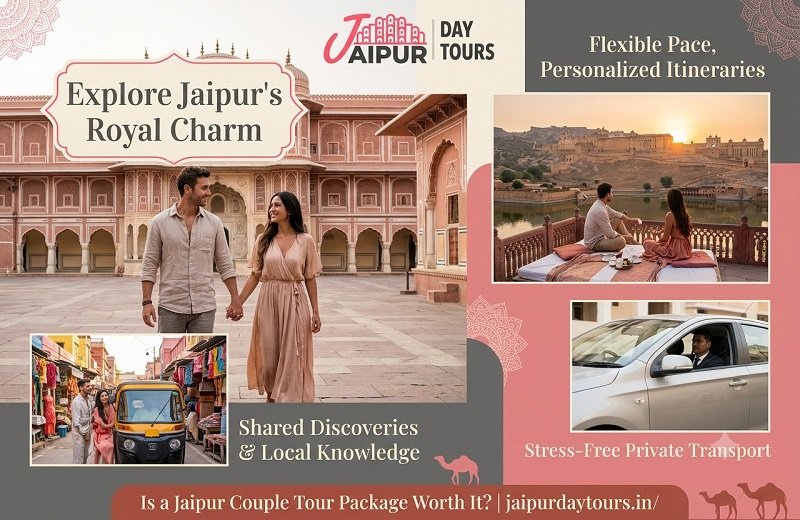
Couples often seek experiences that balance comfort, shared discovery, and practical planning when visiting historic cities. Jaipur, with its forts, palaces, and colorful streets, frequently appears on such lists. Value depends on how well a planned itinerary matches the couple’s pace, interests, and budget, not on any single label.
Understanding Value in a Jaipur Couple Tour Package
A Jaipur Couple Tour Package typically bundles transport, entry coordination, and a set of stops that many first-time visitors want to see together. Academic studies on leisure travel note that shared decision-making and reduced logistical friction can increase satisfaction for pairs. When the package keeps the schedule flexible enough for unplanned moments yet structured enough to avoid wasted time, couples report higher enjoyment. Value appears when the included elements match the time available and the physical comfort both partners prefer. Overly rigid schedules or repeated stops at the same commercial points tend to lower that sense of worth.
Places to Visit in Jaipur in Half Day
Many travelers have only a short window and still want a meaningful overview. Places to Visit in Jaipur in Half Day often center on the City Palace complex, Jantar Mantar, and a quick look at Hawa Mahal from the outside. These sites sit close enough that a focused circuit can be completed without rushing if traffic is considered. Research on destination image shows that even brief, well-chosen exposures can form lasting positive impressions when the visitor feels unhurried. Couples who prefer fewer locations but deeper observation at each one usually find half-day routes more rewarding than attempts to cover everything in limited hours.
Role of a Reliable Car Rental Company
Independent movement between sites becomes simpler when a trusted Car Rental Company supplies a vehicle suited to the couple’s needs. Local operators who know parking constraints near major monuments reduce stress. Studies of urban tourism mobility emphasize that private transport allows pairs to adjust departure times and rest stops according to their own energy levels. The practical advantage lies in predictable pick-up and drop-off points rather than in any claim of luxury. Couples who value privacy and control over the day’s rhythm often cite this option as a quiet contributor to overall satisfaction.
Jaipur City Tour Taxi Options for Shared Exploration
A Jaipur City Tour Taxi provides another common way to move through the old city and surrounding landmarks. Drivers familiar with one-way systems and peak-hour patterns help couples avoid the fatigue of navigating unfamiliar roads. Tourism geography literature points out that local knowledge embedded in taxi services can surface small cultural details that standard maps omit. When the vehicle remains available for the full circuit, partners can decide on the spot whether to linger at a viewpoint or move on. This flexibility supports the sense of shared agency that many couples seek.
Considering a Luxury Golden Triangle Tour
Some pairs extend their stay beyond Jaipur and look at broader circuits. A Luxury Golden Triangle Tour links Jaipur with Delhi and Agra under higher comfort standards. Academic reviews of multi-city itineraries note that upgraded transport and carefully timed transfers reduce cumulative tiredness across consecutive days. The decision to invest in such a format rests on whether both partners prioritize smoother transitions and quieter accommodations over independent budget travel. When the itinerary respects realistic travel times between the three cities, the experience tends to feel coherent rather than fragmented.
Planning a Jaipur to Agra One Day Tour
A Jaipur to Agra One Day Tour appeals to couples who want to see the Taj Mahal without an overnight stay. The road distance requires an early start and a clear understanding of entry procedures and traffic variability. Destination management research stresses that realistic timing and contingency buffers are essential for day trips of this length. Couples who treat the journey as a focused excursion rather than a race usually return with a stronger sense of accomplishment. Advance coordination of return transport and rest stops helps maintain comfort for both partners throughout the long day.
Factors That Influence Perceived Worth
Travel researchers consistently identify three elements that shape whether a packaged experience feels worthwhile: alignment with personal interests, quality of local information, and freedom to adjust the pace. When a couple tour format supports these elements, satisfaction rises. Conversely, packages that fill every hour with commercial stops or ignore differing energy levels between partners tend to disappoint. Ethical planning practices recommend transparent communication about what is included and what remains optional so that expectations stay realistic.
Weather, festival calendars, and individual mobility needs also affect outcomes. Winter mornings in Jaipur can be cool enough for comfortable walking; summer afternoons often require shorter outdoor intervals. Couples who build in buffer time and choose clothing suited to the season report fewer moments of frustration. Academic work on couple travel further notes that shared decision-making during the day strengthens the sense of partnership more than any single landmark.
Practical Considerations Before Booking
Before committing to any format, couples benefit from clarifying priorities. Some prefer early starts and quiet interiors; others enjoy evening lights and street-side observation. Checking recent visitor feedback on timing accuracy and driver professionalism provides useful context. Confirming whether entrance fees, guide services, or meal stops form part of the arrangement prevents later misunderstandings. These steps keep the focus on experience quality rather than on marketing claims.
Independent research on destination loyalty shows that first-time visitors who leave with a coherent mental map of the city are more likely to recommend it later. Packages that help create such a map without overwhelming the participants therefore serve both the travelers and the destination’s longer-term reputation.
Conclusion
Whether a Jaipur couple-oriented arrangement proves worthwhile depends less on the label and more on how closely it matches the pair’s preferred rhythm, physical comfort, and curiosity. Half-day circuits, private transport options, multi-city extensions, and focused day trips each offer distinct advantages when planned with realistic timing and transparent inclusions. Couples who treat these formats as tools rather than finished products usually extract greater value. Thoughtful preparation, attention to local conditions, and mutual agreement on pace remain the most reliable predictors of a satisfying shared visit.
Frequently Asked Questions (FAQs)
Que. How many major sites can realistically be covered in a half-day circuit?
Ans. Most half-day routes focus on three to four closely located monuments such as the City Palace area, Jantar Mantar, and an exterior view of Hawa Mahal. Adding more stops usually compresses time at each place and raises fatigue.
Que. Is private transport generally more comfortable than shared group vehicles for couples?
Ans. Private options allow pairs to set their own departure times and rest intervals. Shared vehicles follow fixed schedules that may not suit differing energy levels between partners.
Que. What is a realistic duration for a day trip from Jaipur to Agra?
Ans. The road journey alone takes several hours each way depending on traffic. An early departure, limited time at the main monument, and a late return form the typical pattern. Buffer time for delays is advisable.
Que. Do multi-city circuits require higher physical stamina?
Ans. Consecutive days of travel and sightseeing increase cumulative tiredness. Choosing formats with reasonable transfer times and quieter overnight stays helps manage energy across the full itinerary.
Que. How can couples keep expectations realistic when selecting any packaged format?
Ans. Reviewing what is included, confirming recent timing accuracy, and discussing mutual priorities before booking reduce the chance of disappointment. Transparent communication about optional elements supports better decision-making.
