
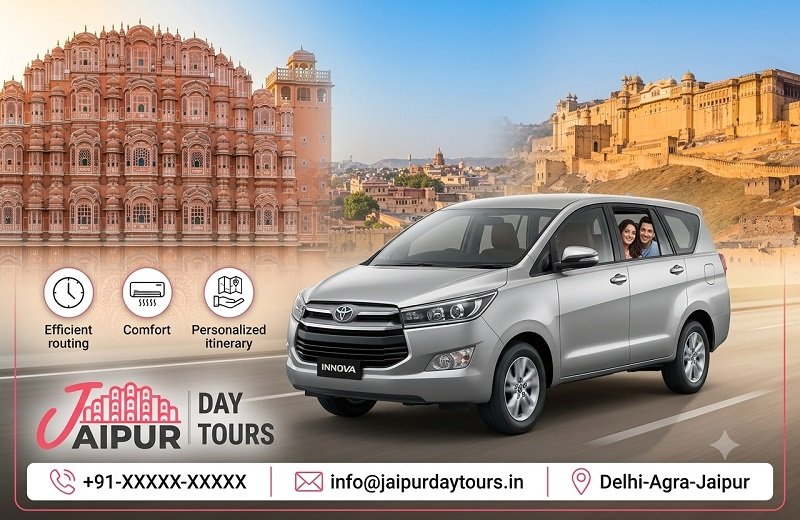
Jaipur attracts visitors with its forts, palaces, and markets. Planning how to move between sites shapes the quality of a short visit. Local transport options include auto-rickshaws, app-based cabs, buses, and private taxis. Each choice carries different effects on time, comfort, and access to multiple locations. Tourism research on urban heritage cities notes that the mode of travel often determines how fully travellers experience clustered monuments within limited hours.
Factors Affecting a Jaipur City Tour Itinerary
A well-structured Jaipur City Tour Itinerary usually covers the Amber Fort area, City Palace complex, Hawa Mahal viewpoint, and one or two markets. Distances between these points are moderate, yet traffic patterns change through the day. Academic observations of visitor movement in Rajasthan’s capital show that fixed public routes rarely match the sequence preferred by first-time travellers. A hired taxi allows adjustment of order and pace according to opening hours, crowd levels, and personal energy.
Drivers familiar with the circuit can suggest practical timing for photography light or quieter entry periods. This flexibility reduces waiting and unnecessary walking in heat. Studies of day-trip behaviour indicate that travellers who control their schedule report higher satisfaction with heritage sites because they avoid rushing or missing secondary attractions such as local craft workshops near the main monuments.
Role of Taxi Hire for Jaipur Ajmer Pushkar Tour
Some visitors extend the day beyond Jaipur city limits. A Jaipur Ajmer Pushkar Tour combines the pink city’s landmarks with the shrine at Ajmer and the sacred lake at Pushkar. Road distances make independent public transport less practical within a single day. Research on regional tourism circuits in Rajasthan highlights that private vehicles enable seamless movement between these three locations while preserving time for meaningful stops rather than transit delays.
Shared buses or trains impose fixed departure times that may not align with preferred visiting windows at each site. A dedicated taxi removes that constraint. Passengers can decide how long to remain at the dargah or the ghats without concern for missing a return connection. Development literature on pilgrimage-linked tourism notes that such control supports both religious observance and cultural observation in the same outing.
Practical Aspects of Half Day Sightseeing in Jaipur
Not every visitor has a full day. Half Day Sightseeing in Jaipur focuses on two or three major monuments, often in the morning or late afternoon. Time pressure increases the value of door-to-door transport. Academic reviews of short-stay tourism emphasise that minimising transfer intervals allows deeper engagement with the selected sites. A taxi waiting at each stop eliminates the search for the next auto-rickshaw or the walk to a bus stand.
This arrangement also helps travellers carrying cameras, water, or light shopping. In warmer months, the ability to rest in an air-conditioned vehicle between locations reduces fatigue. Observations from visitor surveys in similar historic cities confirm that comfort during transit correlates with longer dwell time inside monuments and greater recall of architectural details afterwards.
Rajasthan Tour Packages
Broader travel planning sometimes places a Jaipur day within multi-destination arrangements. Rajasthan Tour Packages frequently list the city as an early or central stop. When the package already includes inter-city transport, an additional local taxi may still prove useful for the dense urban cluster of sights. Coordinators of group movements note that separate city vehicles prevent large coaches from navigating narrow lanes near older markets and smaller temples.
Independent travellers building their own sequence can treat a day taxi as a modular element that fits around overnight stays. The same vehicle might later continue toward other regions if the itinerary expands. This modular approach appears in tourism planning literature as a way to balance structure with personal preference.
Trip to Rajasthan
A single day in Jaipur often forms part of a longer Trip to Rajasthan. The decision to hire a taxi influences how much of the city’s character a visitor absorbs before moving onward. Efficient local movement leaves residual energy for evening cultural programmes or early departure the next morning. Studies of multi-city itineraries show that travellers who resolve intra-city logistics early report smoother transitions between destinations and fewer last-minute adjustments.
Taxi drivers with regional knowledge can also supply practical orientation about road conditions or seasonal variations that affect subsequent legs of the journey. Such information complements guidebooks and digital maps by adding current local detail.
Delhi Agra Jaipur Pushkar Tour
Many circuits begin in the capital and proceed through Agra before reaching Jaipur and optionally Pushkar. A Delhi Agra Jaipur Pushkar Tour typically allocates one intensive day to Jaipur’s monuments. In that compressed schedule, a private taxi maximises the number of accessible sites. Comparative analyses of golden-triangle variations demonstrate that travellers using dedicated vehicles cover more ground and experience less cumulative delay than those relying solely on sequential public options.
The same vehicle can adjust for early starts required by fort opening times or for late finishes near illuminated facades. This adaptability supports both photography interests and quieter observation periods.
Shekhawati Places to Visit
Travellers with extra days sometimes incorporate painted towns north of Jaipur. Shekhawati Places to Visit include frescoed havelis in towns such as Nawalgarh or Mandawa. A taxi arranged in Jaipur can extend northward for a day or form the first stage of a longer loop. Regional tourism research points out that private transport remains the most reliable method for reaching dispersed heritage villages that lack frequent bus connections.
Combining a city day with a Shekhawati extension requires careful timing. A single reliable vehicle simplifies luggage handling and reduces the risk of missed links between the urban core and the rural fresco circuit.
Comfort, Cost, and Control Considerations
Hiring a taxi involves a fixed or kilometre-based payment that is usually higher than shared transport. Against this cost stand measurable gains in time and reduced physical strain. Economic studies of tourist expenditure in heritage destinations indicate that many visitors accept the premium when the alternative is fragmented journeys or incomplete coverage of planned sites. Transparency in quoting helps travellers compare options rationally.
Safety and familiarity also factor into the choice. Licensed drivers and registered vehicles provide a documented service layer that casual street hires may lack. Tourism safety literature consistently links pre-arranged transport with lower incidence of route confusion or unexpected stops.
Group size further influences the decision. Families or small parties often find a single vehicle more economical and cohesive than multiple auto-rickshaws. Solo travellers may weigh the privacy and directness against the lower price of shared modes.
Environmental and Practical Trade-offs
Private vehicles contribute to local traffic volume. Visitors concerned with impact can offset this by choosing efficient routing and combining stops thoughtfully. Some operators maintain newer fleets with better emission standards. Academic work on sustainable urban tourism encourages travellers to prioritise full vehicles and logical sequences that minimise empty kilometres.
Parking near major monuments is regulated. Experienced drivers know designated zones and walking distances, preventing time lost in search or fines. This local knowledge forms an intangible part of the service that maps alone cannot supply.
Conclusion
The choice to hire a taxi for a Jaipur day depends on the desired coverage, available hours, group composition, and tolerance for transit friction. For itineraries that link multiple monuments, extend to Ajmer and Pushkar, or fit within half-day windows, a dedicated vehicle frequently improves both efficiency and comfort. Broader circuits that include Rajasthan Tour Packages, a longer Trip to Rajasthan, a Delhi Agra Jaipur Pushkar Tour, or Shekhawati Places to Visit can also benefit from modular taxi use inside the city. Travellers who match transport mode to the density of their planned stops tend to experience the architectural and cultural layers of Jaipur with less distraction from logistics. Clear advance information on routes, timing, and costs supports an informed decision aligned with personal priorities.
Frequently Asked Questions (FAQs)
Que. Is a taxi necessary for covering the main monuments in one day?
Ans. A taxi is not strictly necessary, yet it reduces transfer time between Amber Fort, City Palace, and Hawa Mahal. Public options exist but require more coordination and may lengthen the overall schedule.
Que. Can a taxi accommodate an extension to Ajmer and Pushkar within daylight hours?
Ans. Yes, provided the start is early and stops are prioritised. Road conditions and traffic determine the exact window; experienced drivers usually advise realistic timings.
Que. How does half-day use differ from a full-day hire?
Ans. Half-day hire focuses on two or three central sites and returns the traveller to a hotel or station. Full-day hire allows wider coverage and optional market time without strict cut-off pressure.
Que. Are there advantages for families or older travellers?
Ans. Continuous vehicle access reduces walking between distant parking points and provides rest between monuments. This arrangement often proves less tiring than sequential public or shared rides.
Que. What information should be confirmed before hiring?
Ans. Confirm the quoted rate structure, included waiting time, vehicle condition, and driver familiarity with the intended circuit. Clear agreement on these points prevents later misunderstandings.
