
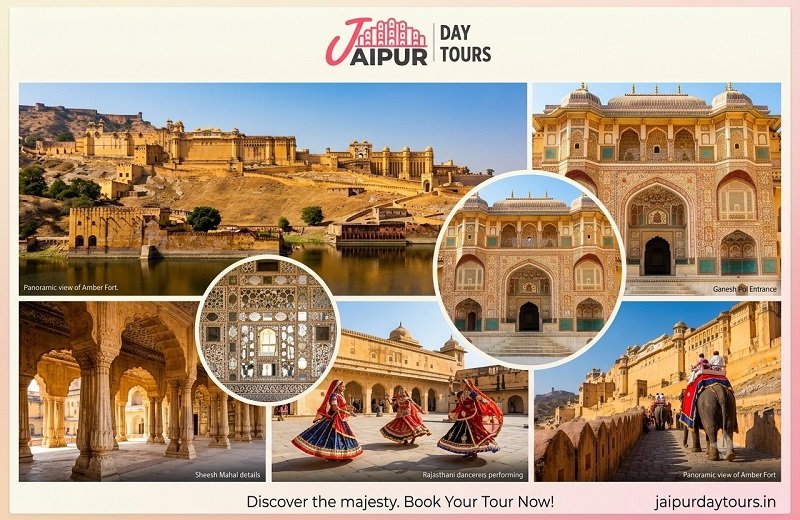
Amber Fort stands on a rocky hill about 11 kilometres from Jaipur city centre. Constructed mainly during the reign of Raja Man Singh I in the late sixteenth century, the complex later received additions under successive Kachwaha rulers. Its elevated position above Maota Lake gave clear defensive advantages while allowing expansive views of the surrounding landscape. Architectural historians note that the fort combines Rajput military planning with refined decorative elements drawn from both local and Mughal traditions. The result is a site that illustrates political power, artistic skill, and practical adaptation to the arid environment of eastern Rajasthan.
Architectural Layout and Artistic Details of Amber Fort
The fort is organised around a series of courtyards that move from public reception areas to more private royal spaces. Diwan-e-Aam, the hall of public audience, features open colonnades supported by carved pillars. Ganesh Pol marks a transition into the inner courts and displays intricate frescoes and lattice work. Sheesh Mahal, or the Mirror Palace, contains thousands of tiny mirror pieces set into plaster so that a single lamp can illuminate the entire chamber. Jai Mandir and Sukh Niwas face each other across a garden court and demonstrate contrasting approaches to temperature control through water channels and shaded verandahs. These spaces show careful attention to climate, ceremony, and visual effect.
Stone carving, inlay work, and wall paintings throughout the complex reflect specialised craft traditions that flourished under royal patronage. Academic studies of Rajasthani architecture emphasise how such decoration served both aesthetic and symbolic purposes, reinforcing the ruler’s status while creating environments suited to court life.
Package Trip to Jaipur and Structured Access to Heritage Sites
Package Trip to Jaipur arrangements commonly schedule time at Amber Fort because the site concentrates several layers of history within a single visit. Travellers following organised itineraries often combine the fort with other monuments in the city, allowing comparison of different building periods and styles. This structured approach helps visitors grasp chronological development without requiring extensive independent research. Research on cultural tourism in India indicates that well-sequenced visits improve understanding of regional history and reduce the sense of fragmentation that can occur when sites are seen in isolation.
The approach roads and entrance systems at Amber Fort have been adapted over time to manage visitor numbers while preserving the original pathways used by royalty and attendants. Elephant processions once formed part of ceremonial entry; today most visitors walk or use vehicles along designated routes. Conservation specialists stress the importance of controlled access so that structural fabric and decorative surfaces remain stable for future study.
Historical Role in Regional Power Structures
Amber served as the capital of the Kachwaha clan before the founding of Jaipur in 1727. The fort therefore represents a transitional moment between earlier hill fortresses and the planned city that followed. Its strategic location controlled trade routes and agricultural land in the surrounding valleys. Political historians observe that control of such positions enabled alliances and resistance during periods of Mughal expansion. The fort’s continued occupation and modification across generations provide material evidence of changing political relationships and architectural preferences.
Inscriptions, portrait galleries, and surviving administrative records linked to the site help scholars reconstruct court protocols and economic networks. These sources confirm that Amber was not merely a defensive outpost but a centre of governance, ritual, and artistic production.
Ranthambore Tour From Jaipur as Complementary Landscape Experience
Ranthambore Tour From Jaipur routes often begin or end with time in the Jaipur region, creating a natural contrast between monumental architecture and forested wildlife reserves. Ranthambore National Park lies roughly 180 kilometres south and preserves dry deciduous forest that once formed part of a larger ecological zone. Visitors who move between the fort and the park encounter two distinct expressions of Rajasthan’s environment: one shaped by human construction and the other by protected natural systems. Ecological studies note that such combined itineraries can heighten awareness of both cultural and biological heritage within the same broader landscape.
The journey itself passes through semi-arid countryside that helps explain why water management features appear so prominently inside Amber Fort. Stepwells, reservoirs, and channelled gardens inside the complex respond directly to the scarcity of reliable rainfall.
Abhaneri Stepwell Jaipur and Water Architecture Connections
Abhaneri Stepwell Jaipur refers to the celebrated Chand Baori located at Abhaneri, approximately 90 kilometres east of the city. This deep stepped well, dating to the eighth or ninth century, belongs to an earlier tradition of water harvesting that continued to influence later Rajput building. Comparing the geometric precision of Chand Baori with the more ornamental water features at Amber Fort reveals continuity and change in engineering approaches across centuries. Archaeological surveys of stepwells across Rajasthan show that these structures combined practical storage with social and ritual functions.
The proximity of Abhaneri to Jaipur makes it a logical extension for travellers already focused on the Amber complex. Both sites demonstrate how communities in dry regions invested substantial labour and design skill in securing water.
Rajasthan Tour Packages
Broader circuits across the state frequently position Amber Fort as an early highlight. These itineraries place the fort within a sequence that may include later city palaces, desert fortifications, and rural settlements. Such sequencing allows observation of how architectural forms adapted to different terrain and political conditions. Studies of heritage tourism patterns indicate that visitors gain clearer chronological and regional understanding when major sites are presented in geographic and historical order.
Trip to Rajasthan
A journey through Rajasthan typically involves movement between contrasting ecological and cultural zones. Amber Fort introduces the eastern hill-fort tradition before travellers encounter the open plains, dunes, or Aravalli ranges farther west and south. This progression helps illustrate the diversity of building responses to climate and security needs across the state.
Delhi Agra Jaipur Pushkar Tour
Circuits that link Delhi, Agra, Jaipur, and Pushkar commonly allocate a full morning or afternoon to Amber Fort. The site provides a Rajput counterpoint to the Mughal monuments of Agra and the religious landscape of Pushkar. Comparative viewing of these places clarifies differences in patronage, religious orientation, and urban planning between successive political centres.
Shekhawati Places to Visit
The Shekhawati region north of Jaipur contains richly painted havelis that represent a later mercantile flowering of Rajasthani art. Travellers who begin with Amber Fort often continue northward to observe how fresco traditions evolved from royal to commercial contexts. The visual language of colour, narrative, and surface decoration shows both continuity and adaptation across different social groups.
Conservation Challenges and Ongoing Research
Amber Fort faces pressures common to heavily visited monuments: surface wear, moisture damage, and the need to balance access with preservation. Archaeological and conservation teams monitor structural stability, pigment condition, and visitor impact. Academic publications regularly report findings from cleaning trials, material analysis, and documentation projects. These efforts aim to maintain the fort as both a functioning heritage site and a source of reliable historical evidence.
Climate patterns in the region add further complexity. Seasonal temperature extremes and occasional heavy rain test the resilience of lime plaster, sandstone, and decorative finishes. Long-term management plans therefore incorporate both traditional maintenance knowledge and modern monitoring techniques.
Visitor Experience and Interpretive Value
Walking through the successive courtyards of Amber Fort offers a clear spatial narrative. Public spaces give way to semi-private and private zones, reflecting hierarchical court organisation. Elevated terraces provide panoramic views that once served defensive observation and now allow appreciation of the fort’s relationship to the lake and surrounding hills. Interpretive material at the site, when carefully prepared, helps visitors connect visible features with documented history rather than relying solely on visual impression.
Scholars of museum and heritage studies argue that sites of this complexity reward slow observation. Details of joinery, water flow, and decorative repetition become apparent only with time and repeated viewing from different angles.
Conclusion
Amber Fort remains a significant place of study and observation because it concentrates military planning, artistic achievement, and environmental adaptation in one coherent complex. Its architecture records successive phases of Kachwaha rule and interaction with wider political currents. Connections to nearby water structures, wildlife landscapes, and other regional centres place the fort within a larger network of Rajasthani heritage. Careful conservation and informed visiting practices help ensure that the site continues to yield historical insight while remaining accessible. In this way, Amber Fort functions as both a monument of the past and a resource for understanding the cultural geography of Rajasthan.
Frequently Asked Questions (FAQs)
Que. When was Amber Fort primarily constructed?
Ans. Construction began in the late sixteenth century under Raja Man Singh I, with later additions by subsequent rulers of the Kachwaha dynasty.
Que. What is the significance of Sheesh Mahal inside the fort?
Ans. Sheesh Mahal contains extensive mirror inlay work designed so that minimal light can illuminate the entire chamber, demonstrating advanced decorative technique and control of illumination.
Que. How does Amber Fort relate to the later city of Jaipur?
Ans. Amber served as the earlier capital of the Kachwaha rulers. Jaipur was founded in 1727 as a new planned city, after which the fort continued in use but no longer functioned as the primary seat of government.
Que. Why are water features prominent in the fort complex?
Ans. The surrounding region receives limited and seasonal rainfall. Reservoirs, channels, and cooled chambers reflect practical responses to water scarcity and temperature extremes.
Que. What conservation issues currently affect Amber Fort?
Ans. Surface wear from visitor traffic, moisture-related damage to plaster and paint, and the need to manage large numbers of people while protecting original fabric are among the main concerns addressed by ongoing conservation programmes.
